
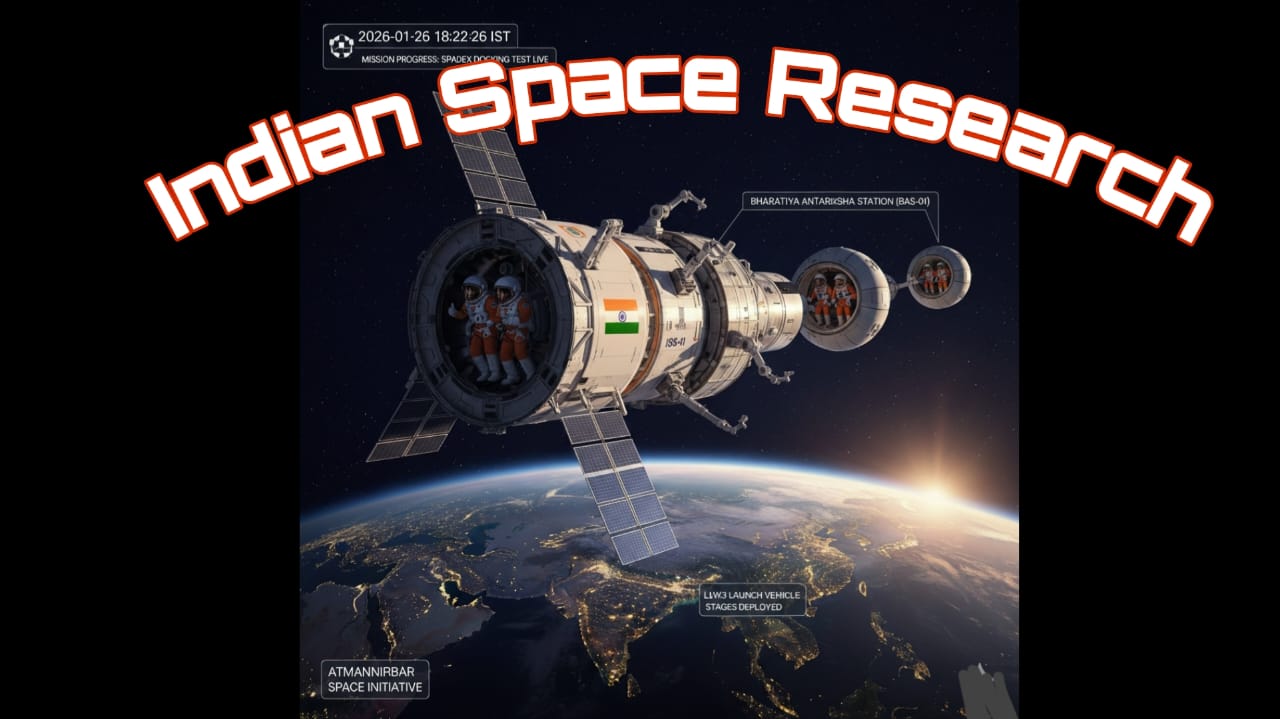
India’s Own Space Station: ISRO Takes the First Leap—When Will It Be Ready?
A new golden chapter in space science has begun for India. After conquering the Moon’s south pole and heading toward the Sun, the Indian Space Research Organisation (ISRO) has now taken its first concrete step toward building India’s permanent home in space: the Bharatiya Antariksha Station (BAS).
This isn’t just a scientific project; it is a symbol of India’s strategic sovereignty and growing prowess in the “New Space” era. Here is everything you need to know about this historic mission.
Bharatiya Antariksha Station (BAS): The Blueprint
The Indian Space Station is a massive leap toward an ‘Aatmanirbhar’ (Self-reliant) space program. ISRO has recently initiated the procurement and manufacturing phase for the first module, BAS-01, collaborating with domestic aerospace giants.
Key Highlights:
- Orbit: It will be positioned in the Low Earth Orbit (LEO) at an altitude of approximately 400 to 450 km.
- Mass: The completed station is expected to weigh around 52 tonnes, with the first module (BAS-01) weighing roughly 10 tonnes.
- Capacity: In its initial phases, it will be able to house 3 to 4 astronauts for extended stays to conduct microgravity experiments.
The Timeline: When Will It Be Operational?
ISRO has laid out a clear, phased roadmap to realize this dream:
- 2028: The First Module (BAS-01)Following recent Union Cabinet approvals, ISRO aims to launch the first base module by 2028. This will be launched using India’s heaviest rocket, the LVM3.
- 2035: Full OperationalityThe station will be built incrementally. By connecting a total of 5 modules, the Bharatiya Antariksha Station is slated to be fully functional by 2035.
- 2040: The Lunar GoalThe space station serves as a stepping stone. The experience gained here will be vital for India’s ultimate goal: landing an Indian astronaut on the Moon by 2040.
Gaganyaan: The Foundation
The success of the space station is deeply linked to the Gaganyaan Mission. Gaganyaan is India’s first crewed flight, which will prove that ISRO can safely send humans to space and, more importantly, bring them back.
- Docking Technology: A critical “Space Docking Experiment” (SPADEX) is scheduled soon. This technology allows two spacecraft to join in orbit—an essential skill for building a station piece-by-piece.
- Life Support: The Environmental Control and Life Support System (ECLSS) being developed for Gaganyaan will be scaled up for the permanent station.
Why Does India Need Its Own Space Station?
Currently, the International Space Station (ISS) and China’s Tiangong are the only active outposts. Having an indigenous station offers several strategic advantages:
- Microgravity Research: Conducting experiments in biology, pharmaceuticals, and materials science that are impossible under Earth’s gravity.
- Economic Hub: It opens doors for Space Tourism and private sector participation in satellite servicing.
- Strategic Independence: India will no longer need to rely on foreign agencies to conduct long-duration human spaceflight research.
Final Thoughts
If Chandrayaan-3 proved India’s precision, the Bharatiya Antariksha Station will prove India’s endurance. We are no longer just “visitors” in space; we are becoming “residents.” This mission is a testament to the fact that for the new India, even the sky is not the limit.
Do you think ISRO will beat its 2035 deadline given its recent track record of efficiency? Let us know your thoughts in the comments!
Yess