
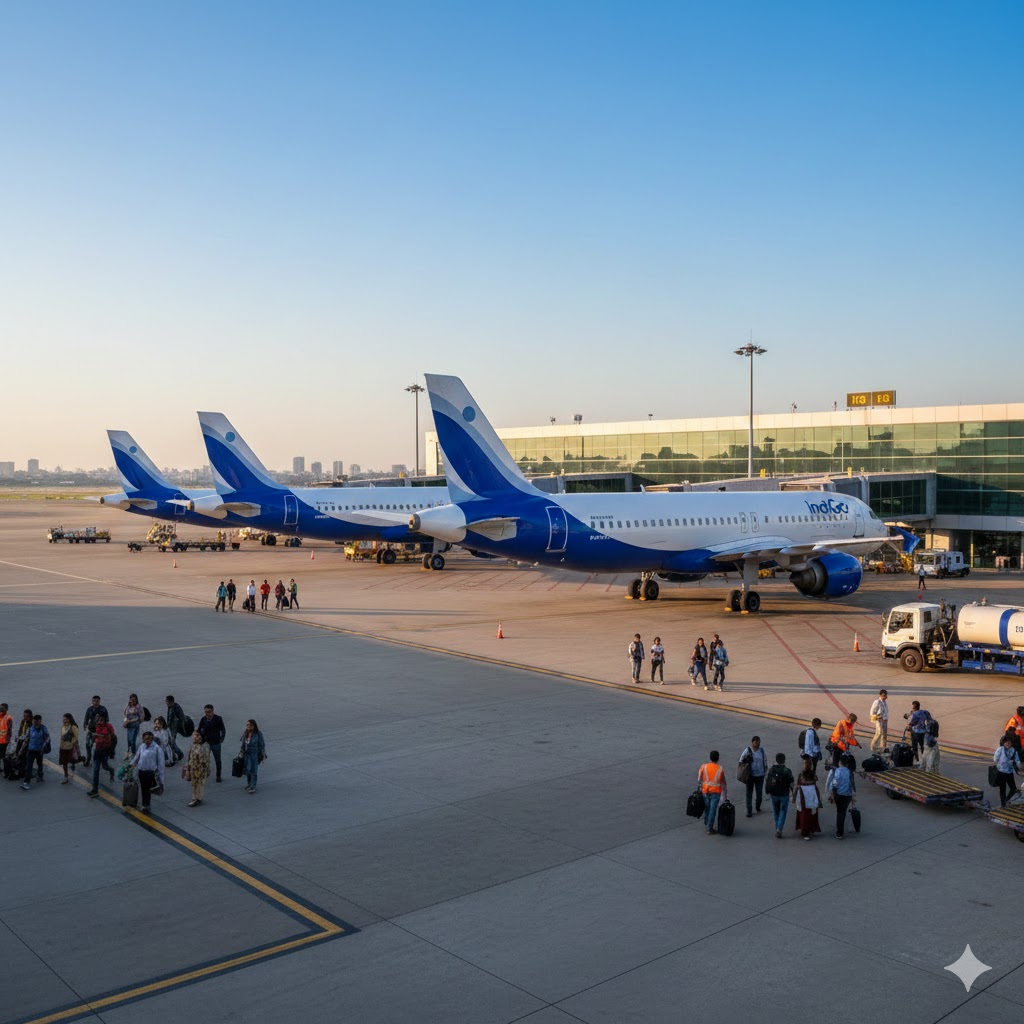
Here is a comprehensive post chronicling IndiGo’s journey from its ambitious start to its current status as a global aviation powerhouse in 2026.
✈️ IndiGo: From a “Low-Cost” Dream to Sovereign of the Skies (2006–2026)
When a single indigo-and-white aircraft took off from Delhi to Guwahati in August 2006, few could have predicted that it would one day command over 60% of the Indian sky. Today, in 2026, IndiGo (InterGlobe Aviation) is no longer just an airline; it is the vital pulse of Indian connectivity.
🕒 The Beginning: Precision Over Frills (2006 – 2010)
IndiGo was co-founded by Rahul Bhatia and Rakesh Gangwal with a vision that was deceptively simple:
- Low Fares: Making flying affordable for the common man.
- On-Time Performance: Treating punctuality as a religion.
- Hassle-free Experience: Clean planes and quick service.
While competitors were focusing on luxury and “full-service” perks, IndiGo focused on the Airbus A320. By using a single type of aircraft, they kept maintenance costs low and operations incredibly efficient.
🚀 The Ascent: Becoming India’s No. 1 (2011 – 2015)
In 2011, IndiGo shocked the global aviation industry by placing a record-breaking order for 180 aircraft. This move signaled their intent to dominate.
- 2012: Within just six years of its first flight, IndiGo became India’s largest airline by market share, overtaking legacy carriers.
- 2015: The company went public with a massive IPO, proving that “Low-Cost” could also be “High-Profit.”
🌍 Expansion: Connecting the Unconnected (2016 – 2023)
IndiGo didn’t just fly between metros; it unlocked “Regional India.” Through the UDAN scheme and a growing fleet of ATR aircraft, it connected towns that had never seen a commercial flight.
- Global Footprint: The “6E” code began appearing on screens in Dubai, Singapore, Istanbul, and beyond.
- Historic 2023 Order: At the Paris Air Show, IndiGo placed an order for 500 Airbus A320 family aircraft—the largest ever in commercial aviation history.
🌟 IndiGo Today: The 2026 Pivot
As of January 2026, IndiGo has evolved into a “Global Hybrid” carrier. It is no longer “just” a budget airline.
- IndiGoStretch (Business Class): Responding to a growing corporate market, IndiGo now offers a premium business cabin on its busiest routes, featuring luxury seating and gourmet dining.
- The Long-Haul Era (A321XLR): With the induction of the Airbus A321XLR in early 2026, IndiGo has begun non-stop flights to Athens, with plans to reach further into Europe and Asia.
- The Fleet: Now exceeding 430 aircraft, with an eye toward a 600-aircraft fleet by 2030.
⚠️ Navigating Challenges
The journey hasn’t been without turbulence. In early 2026, the airline has had to face strict DGCA oversight and penalties regarding pilot rest norms and operational disruptions following a chaotic 2025 winter. However, the airline’s focus on “Operational Resilience” and its robust financial health continue to keep it ahead of the competition.
The Three Secrets of IndiGo’s Success:
- Consistency: One type of aircraft (mostly) means easier training and cheaper spare parts.
- Sale and Leaseback: A smart financial model that keeps the fleet young and the balance sheet light.
- Customer Trust: In a country where time is money, “IndiGo is on time” became the ultimate marketing slogan.
Conclusion:
IndiGo’s story is a masterclass in discipline. It proved that in a volatile industry like aviation, simplicity and reliability are the ultimate luxuries. As it begins non-stop flights to Europe this month, the “Blue Revolution” shows no signs of slowing down.
Have you tried the new ‘IndiGoStretch’ Business Class yet? Share your experience in the comments below! 👇
#IndiGoAirlines #AviationIndia #SuccessStory #Travel2026 #BusinessTravel #Airbus #6E #StartupIndia #AviationHistory